
April is International Irritable Bowel Syndrome Awareness month!
The National Institute for Health and Clinical Excellence (NICE), who are responsible for providing national guidance on promoting good health and preventing and treating ill health, advise GPs to refer patients with Irritable Bowel Syndrome (IBS) for psychological interventions (CBT, Hypnotherapy or Psychotherapy) if they have not responded to pharmacological treatments.
BBC News reported last year on a gastroenterologist who refers his clients with Irritable Bowel Syndrome for Hypnotherapy. In a study he carried out, 9 out of 10 of his patients had their IBS symptoms improve significantly. Read the full article - Hypnotherapy can help with Irritable Bowel Syndrome.
Irritable Bowel Syndrome can be quite unpleasant at times and can have a big impact on the life of the sufferer. Hypnotherapy helps to reduce stress levels which in turn helps reduce the symptoms associated with irritable bowel syndrome.
Find out more on how hypnotherapy can help Irritable Bowel Syndrome on my Bristol Hypnotherapy website.
Showing posts with label Stress Relief. Show all posts
Showing posts with label Stress Relief. Show all posts
Friday, 15 April 2011

Thursday, 23 July 2009
Finding a Counselling
Over an average year, around one in four people will experience some kind of mental health problem - whether it is due to work-related stress, a family crisis, or something more serious like abuse. Depression is the most common mental illness, affecting one in five people.
Sometimes just taking some time out to look after yourself, de-stress and relax is enough to help with your state of mind, but in some cases people need a little bit more. Counselling can help to address issues which may be contributing to stress, anxiety and depression. Counselling and complementary therapies work quite nicely together because whilst counselling is dealing with the underlying issues, the massage or other complementary therapy is helping to reaffirm a calmer state of mind. As a complementary therapist, I studied some basic counselling skills as part of my training and I like to think that I am a good listener but I am not a counsellor – far from it! If I feel that a client of mine would benefit from counselling in addition to their treatment with me, then I would suggest it to them and/or refer them on to a counsellor.
Of course, the decision to undertake counselling is not one that anyone takes lightly. Many consider the idea for months or even years before deciding to take the plunge. The main hurdle anyone must overcome before opening themselves up to counselling is accepting they have a problem that needs to be dealt with. Often friends and family will try to encourage the person to accept they need help, but the decision must ultimately come from the person themselves.
Finding the right counsellor is essential. Counsellors often specialise in certain areas, so it’s important the individual finds one that addresses their specific needs, with an approach they are comfortable with. It can be quite a daunting task finding a counsellor nowadays what with their being so many different approaches. I personally think it has become overly complicated for people to decide on whom to go see - person centred, gestalt, transactional analysis, core process, psychotherapy, integrative, humanistic, cognitive – the list goes on. You almost need to be an expert in counselling yourself to know which one to go for! My advice would be to do some research – check out what the different approaches are and whether you think they will help you – give a few counsellors a call to discuss what they offer. Some counsellors give a free first meeting to discuss their techniques which might be worth giving a go before committing to seeing them regularly.
When choosing a counsellor, it is important to ensure that they are fully qualified to practise. Being accredited by a professional body, such as the British Association for Counselling and Psychotherapy (BACP), means that the counsellor will have met several criteria including completing a certain number of hours in training and practising under supervision.
To find a local therapist, I would recommend checking out the BACP website or the Counselling Directory. Both sites have a ‘Find a Therapist’ search facility. On the Counselling Directory, each counsellor listed has their own profile page with information about themselves, their approaches, what areas they deal with, and all their training, qualification, experience and fees. It also has lots of informative articles written by counsellors, as well as comprehensive information on all kinds of distress to help people identify their problems and become informed, not scared. There’s also a blog that reports the latest health news and developments.
At The Healing Rooms in Bristol, where I practice complementary therapies, there are a number of counsellors and psychotherapists, several of which are BACP accredited and listed with the Counselling Directory. Here are their details if you would like to get in touch with them:
Mo Cahill - 0117 973 6503 or 07922 254 618
Natalie Brooks - 07973 267232
Helen Gunson - 0117 951 7878
Other related external links:
UKCP
Relate
Counselling Society
Monday, 20 July 2009
Massage Increases Life Expectancy
While browsing the internet I came across a press release from Medical Massage Care reporting that Therapeutic Massage has been proven to increase life expectancy.
It mentions that
Check out the full press release - Therapeutic Massage Proven to Increase Life Expectancy, Based on Actuarial Study by Medical Massage Care

“An actuarial analysis performed by Medical Massage Care indicates that therapeutic massage tends to increase life expectancy. There is a positive correlation between the number of massage therapists per 1,000 residents of a state and the life expectancy for that state.”This study was carried out in the United States and shows that as the number of massage therapists per resident increases, the life expectancy tends to increase too. Hawaii came out on top! It would be interesting to see what the statistics are like for the United Kingdom and the regions within it.
It mentions that
“massage increases life expectancy as a result of the positive physiological effects of soft tissue manipulation.”This soft tissue manipulation increases the circulation of blood and lymph around the body helping to rid the body of waste products and delivers much needed oxygen and nutrients to every living cell. This helps the body speed up healing and tissue repair enabling our body to recover from injury and illness quicker; regulates blood pressure; and most importantly reduces stress, tension, and anxiety. It is well known that people suffering with long-term stress are at a higher risk of having a heart attack so taking steps to lower stress levels, such as having regular massage, is very advantageous and can help lower this risk.
Check out the full press release - Therapeutic Massage Proven to Increase Life Expectancy, Based on Actuarial Study by Medical Massage Care
Sunday, 12 July 2009
Stress Relief Bath Blend
To help you relax and unwind after a hard day at work, try this soothing aromatherapy bath time blend.
Mix half a cup of full fat milk, 1 tbsp of runny honey, 2 drops lavender, 2 drops sweet marjoram, and 2 drops geranium together in a bowl ensuring that it is mixed well and the essential oils have dispersed. Add the blend to the bath just as you get in. relax in the bath for at least 20 minutes

Mix half a cup of full fat milk, 1 tbsp of runny honey, 2 drops lavender, 2 drops sweet marjoram, and 2 drops geranium together in a bowl ensuring that it is mixed well and the essential oils have dispersed. Add the blend to the bath just as you get in. relax in the bath for at least 20 minutes
Wednesday, 8 July 2009
Abdominal Breathing for Health and Stress Relief
“When the breath is irregular, the mind is also unsteady, but when the breath is still, so is the mind.” Hathayogapradipika (14th century)Many thousands of years ago, yogis like Hathayogapradipika mentioned above, established that there is a close link between our state of mind and the way we breathe.
The majority of people only use a third of their maximum lung capacity when they breathe in. This can be due to habit, respiratory problems, and as a result of stress and anxiety.
Every living cell in the body needs oxygen. We obtain the oxygen we require when we breathe in. If we are not using our lungs to their full potential, we are not getting the oxygen our body requires which can have a big affect on our health. Most pathogens such as bacteria and viruses thrive in a low oxygen environment causing us to become fatigued and unwell. A lack of oxygen in the body can also slow down our bodies healing abilities.
When we are in a state of relaxation, for instance when we are meditating or having a massage, our breathing becomes slower, deeper and more regular. Deep breathing (abdominal breathing not chest breathing) fully expands and contracts the lungs causing a huge increase in the amount of oxygen which is absorbed into the blood.
Abdominal breathing takes a little getting used to but really does help induce a state of relaxation and helps reduce stress. To see that you are breathing correctly (from the abdomen and not the chest), place one hand on your abdomen and the other on your chest. When you breathe in, the hand which is on your abdomen should rise higher than that of the one on your chest. Once you’ve got use to the technique, you don’t need to place your hands on your abdomen and chest. Inhale through the nose, hold for a count of seven, and then exhale through the mouth. Inhalation should be twice as long as exhalation.
Try this breathing technique once or twice a day, or perhaps when you are feeling particularly stressed, anxious, or in pain. The more this technique is practised, the more natural it will become.
Sunday, 28 June 2009
Meditative Massage
I found this simple but effective meditation exercise in a book called 1001 Meditations: How to Discover Peace of Mind by Mike George. It is an excellent meditation to use in between your real massages. It will help you to release any tension in your muscles, relax you, and de-stress you. Give it a go…
Sit or lie down so that you are comfortable and close your eyes. Visualise someone stood behind you massaging your shoulders with their healing hands. As they massage, you can feel the tension releasing, the knots fading away, and your shoulders relaxing. Visualise your imaginary massage therapist moving on to your arms and hands, then to your legs and feet, your back, face and head, working at relieving the tension in those areas as they go. Continue with the visualisation until you are feeling relaxed and at ease.

 by Mike George. It is an excellent meditation to use in between your real massages. It will help you to release any tension in your muscles, relax you, and de-stress you. Give it a go…
Sit or lie down so that you are comfortable and close your eyes. Visualise someone stood behind you massaging your shoulders with their healing hands. As they massage, you can feel the tension releasing, the knots fading away, and your shoulders relaxing. Visualise your imaginary massage therapist moving on to your arms and hands, then to your legs and feet, your back, face and head, working at relieving the tension in those areas as they go. Continue with the visualisation until you are feeling relaxed and at ease.
Friday, 26 June 2009
The Solar Plexus Reflex

The Solar Plexus is also a point at which one of the main chakras is found and is called the solar plexus chakra or manipura. This chakra is associated with the colour yellow and represents the “self”, individuality, ego, personality, confidence, and self-esteem. It is a personal power centre.
According to Theron Q. Dumont, author of The Solar Plexus or Abdominal Brain
 ,
“its name, “solar”, was bestowed upon it by reason of (1) its central position; (2) the fact that its filaments extend in all directions to the important abdominal organs, like the rays of the sun; and (3) the fact it is recognised as being the power-house, and great reservoir of ”life-force”, just as the sun is the great power-house and reservoir of material energy of our solar system.”In Reflexology, the Solar Plexus reflex is located on the diaphragm line between zones 2 and 3. To non-reflexologists, this point can be found at the apex of the arch that runs across the base of the ball of the foot. To help locate this reflex, squeeze the sides of your foot together to find the hollow. This hollow is where the solar plexus is.
Working on this reflex can relieve stress and nervousness, aid relaxation and deep regular breathing, and restore a feeling of calm making it beneficial for people suffering from anxiety, depression, stress-related conditions, nervous disorders, asthma, and hyperventilation to name a few. As this reflex helps calm and relax the entire nervous system it should be worked in cases of migraine, multiple sclerosis, epilepsy, stroke, Parkinsons’s disease, and any other nervous system disorder.
The Solar Plexus is one of the most important reflexes used in Reflexology and is worked at the beginning and the end of a Reflexology treatment. It allows the therapist time to attune to the client and also allows energies to flow freely between client and therapist. It also prepares the client for the treatment, inducing a state of relaxation and encouraging deep relaxed breathing. According to Valerie Voner, author of Everything Reflexology
 , when this point is worked it can reduce the congestion felt in other reflexes. So if a reflex is painful, the solar plexus can be worked to help reduce or eliminate this pain response.
The Solar Plexus or the “Bubbling Spring” point, as it is known in acupressure and acupuncture, is the first point on the kidney meridian (K1) and is believed to help with fatigue and lethargy. In the Indian tradition, this point is the Earth chakra which helps balance the whole body, and as in acupressure/acupuncture, it is an important point for grounding and connecting with the earth.
An effective way to work with the Solar Plexus reflex is to place your thumb on the point as pictured and apply pressure for a few seconds then release. Continue to do this for 30 seconds to a minute. You might like to inhale as you press and exhale as you release. You can also press firmly on this point with your thumb and rotate in a clockwise direction – both methods are effective. Repeat this technique on the other foot. If you are not supple enough to reach down to work on your feet, you can also access the solar plexus reflex on the hand.
References:
Reflexology and Acupressure
 by Janet Wright
True and Useful Blog post - Acupressure Point: Bubbling Spring Point (K 1)
Footworks Blog post - The Solar Plexus - The Abdominal Brain

Saturday, 6 June 2009
Reiki and its Affects on the Nervous System
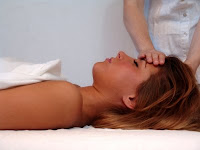
The autonomic nervous system consists of two opposing parts – the sympathetic and parasympathetic. The sympathetic nerves are responsible for actions in times of stress, for example, when you feel threatened; this part of the nervous system stimulates the adrenal glands to produce adrenalin. The body is returned to normal by the parasympathetic part of the nervous system when the threat has gone. The parasympathetic nerves are responsible for controlling your body’s everyday tasks such as digestion. This part of the nervous system helps the body relax by slowing the heart rate and lowering blood pressure among other things.
A research study looked into the changes that occurred to the autonomic nervous system during a Reiki treatment. 45 participants were split in to three groups. The first group received no treatment and were just left to rest; the second group received a Reiki treatment from an experienced Reiki practitioner; and the third group received a placebo treatment in which a person with no knowledge of Reiki mimicked a Reiki treatment. Various aspects of autonomic nervous system function were tested prior to, during, and after the treatments. Results showed that the heart rate and diastolic blood pressure decreased significantly in the participants who received Reiki compared to those who received the placebo and no treatment.
This was a small study but it does show some positive results which will hopefully lead to more research being done in Reiki.
Reference:
Nicola Mackay, Stig Hansen, Oona McFarlane. Autonomic Nervous System Changes During Reiki Treatment: A Preliminary Study. The Journal of Alternative and Complementary Medicine. December 2004, 10(6): 1077-1081. doi:10.1089/acm.2004.10.1077.

Wednesday, 20 May 2009
How to make your own Aromatherapy Dough
Play dough infused with essential oils can be played with to aid relaxation, help reduce stress, improve flexibility and mobility in the finger and wrist joints, and reduce stiffness and pain in the hands. It’s also great fun. Ready made aromatherapy dough is available but I thought in this post I would explain how to make your own aromatherapy dough.
To make your dough, you will need: 2 cups flour, 2 cups warm water, 1 cup salt, 2 tbsp vegetable oil, 1 tbsp cream of tartar, food colouring (optional), essential oils of your choice
Mix all the ingredients together (except the essential oils) in a saucepan and place over a low heat, stirring continuously. When the dough starts to form a clump in the middle of the pan, remove from the heat and allow to cool. The dough shouldn’t be sticky so if it is, you need to cook it for a bit longer. Once it has cooled, make a hollow in the dough ball, add your essential oils to it, and need well to distribute the oils throughout the dough. And there we have it – your very own aroma dough! In between use, store your dough in an air tight container.
Add lavender, neroli, sandalwood or frankincense essential oils for stress relief and relaxation. Add eucalyptus, cajuput, plai, black pepper or ginger essential oils for rheumatism, arthritis, and repetitive strain injuries.
Saturday, 4 April 2009
Stress Busting Essential Oils
“Today the use of essential oils is becoming increasingly popular as people realise the benefits the oils have in helping to de-stress the mind and body.” Francesca Gould writes in her book Aromatherapy for Holistic Therapists .
Stress can cause many physical and psychological health problems including: headaches, anxiety, can trigger asthma attacks, high blood pressure, insomnia, irritable bowel syndrome, psoriasis, lowers the immune system making you more susceptible to colds and flu, nervous breakdown, indigestion, depression, menstrual problems, heart attacks, stomach aches and ulcers to name a few.
Following on from a previous post about combating stress during the economic downturn , I thought I would discuss a few essential oils you can use at home that can be very beneficial at stress busting and helping you to relax. I will also discuss in this post various ways to use these essential oils.
Top Note Essential Oils
Basil is an anti-depressant and neurotonic (helps strengthen the nervous system) and can be helpful for stress-related problems, insomnia, mental fatigue, and anxiety. It is also anti-spasmodic and digestive so can help with irritable bowel syndrome, indigestion, asthma, and muscle tension. It can also help with tension headaches and migraines as it is an analgesic. It helps poor memory by improving concentration something which tends to be a problem when we have a lot on our mind.
Bergamot is a nice oil which can be both uplifting and calming. It is excellent for anxiety, insomnia, fatigue, and stress-related problems. It is also a neurotonic and an anti-depressant. It is great for skin conditions such as eczema and psoriasis which can be triggered by stress.
Clary sage is an anti-depressant, sedative and a relaxant. It can help with depression, anxiety, shock, hysteria, stress-related illness, and can help lower blood pressure which is often higher when we are stressed. It also helps to balance the hormones. More information on Clary sage can be found in the Essential Oil of the Week: Clary Sage post.
Middle Note Essential Oils
Lavender is a relaxant, sedative, and anti-depressant. It helps to lower blood pressure which can often be high when stressed. More information on lavender can be found in the Essential Oil of the Week: Lavender post.
Chamomile is sedative in nature and can be useful for insomnia, anxiety, stress and tension. It is also an anti-depressant. All forms of Chamomile can be beneficial for stress-related conditions. I personally prefer Roman Chamomile but it tends to be more expensive.
Geranium is a very balancing oil, especially for women. It is an anti-depressant and relaxant and stimulates the adrenal cortex of the adrenal glands helping to relieve stress, anxiety, fatigue, shock, depression, pre-menstrual syndrome, menopausal symptoms and other stress related conditions.
Base Note Essential Oils
Ylang-ylang is beneficial for over rapid breathing (hyperventilation) which can occur during anxiety/panic attacks or just from an increased level of stress. It also helps palpitations, insomnia, over rapid heart rate, and other stress related conditions. It is one of my favourite oils.
Frankincense is good for emotional problems, tiredness, anxiety, confidence problems, depression, headaches, irritability, hyperventilation, and stress-related conditions. More information on frankincense can be found in the posts Essential Oil in focus : Frankincense and the Frankincense – The New Antidepressant.
Patchouli is an anti-depressant and neuro-tonic
Ways of using the oils
Bath: Dilute the chosen essential oils (4-6 drops) first in a teaspoon of milk and then add to the bath just before you get in.
Oil Burners: Further information on how to use an oil burner can be found in a previous post. If you can’t find a suitable burner or don’t want to pay out for one, you could just add a couple drops of your chosen essential oil on to a piece of cotton wool or tissue and place on a radiator. The heat will cause the oil to evaporate and the relaxing aroma will be released into the room.
Massage: Add 5 drops of your chosen essential oils to 10ml (2 tsp) of carrier oil (grape seed oil or sweet almond oil are good choices). There are many self-massage techniques which you can use or you could get someone else to do it for you.
If you are not sure whether the oils are suitable for you or not, especially if you have any medical conditions, it is best to consult a qualified Aromatherapist first. Also, before using any essential oils on the skin, it is advisable to perform a patch test first.

. Stress can cause many physical and psychological health problems including: headaches, anxiety, can trigger asthma attacks, high blood pressure, insomnia, irritable bowel syndrome, psoriasis, lowers the immune system making you more susceptible to colds and flu, nervous breakdown, indigestion, depression, menstrual problems, heart attacks, stomach aches and ulcers to name a few.
Following on from a previous post about combating stress during the economic downturn , I thought I would discuss a few essential oils you can use at home that can be very beneficial at stress busting and helping you to relax. I will also discuss in this post various ways to use these essential oils.
Top Note Essential Oils
Basil is an anti-depressant and neurotonic (helps strengthen the nervous system) and can be helpful for stress-related problems, insomnia, mental fatigue, and anxiety. It is also anti-spasmodic and digestive so can help with irritable bowel syndrome, indigestion, asthma, and muscle tension. It can also help with tension headaches and migraines as it is an analgesic. It helps poor memory by improving concentration something which tends to be a problem when we have a lot on our mind.
Bergamot is a nice oil which can be both uplifting and calming. It is excellent for anxiety, insomnia, fatigue, and stress-related problems. It is also a neurotonic and an anti-depressant. It is great for skin conditions such as eczema and psoriasis which can be triggered by stress.
Clary sage is an anti-depressant, sedative and a relaxant. It can help with depression, anxiety, shock, hysteria, stress-related illness, and can help lower blood pressure which is often higher when we are stressed. It also helps to balance the hormones. More information on Clary sage can be found in the Essential Oil of the Week: Clary Sage post.
Middle Note Essential Oils
Lavender is a relaxant, sedative, and anti-depressant. It helps to lower blood pressure which can often be high when stressed. More information on lavender can be found in the Essential Oil of the Week: Lavender post.
Chamomile is sedative in nature and can be useful for insomnia, anxiety, stress and tension. It is also an anti-depressant. All forms of Chamomile can be beneficial for stress-related conditions. I personally prefer Roman Chamomile but it tends to be more expensive.
Geranium is a very balancing oil, especially for women. It is an anti-depressant and relaxant and stimulates the adrenal cortex of the adrenal glands helping to relieve stress, anxiety, fatigue, shock, depression, pre-menstrual syndrome, menopausal symptoms and other stress related conditions.
Base Note Essential Oils
Ylang-ylang is beneficial for over rapid breathing (hyperventilation) which can occur during anxiety/panic attacks or just from an increased level of stress. It also helps palpitations, insomnia, over rapid heart rate, and other stress related conditions. It is one of my favourite oils.
Frankincense is good for emotional problems, tiredness, anxiety, confidence problems, depression, headaches, irritability, hyperventilation, and stress-related conditions. More information on frankincense can be found in the posts Essential Oil in focus : Frankincense and the Frankincense – The New Antidepressant.
Patchouli is an anti-depressant and neuro-tonic
Ways of using the oils
Bath: Dilute the chosen essential oils (4-6 drops) first in a teaspoon of milk and then add to the bath just before you get in.
Oil Burners: Further information on how to use an oil burner can be found in a previous post. If you can’t find a suitable burner or don’t want to pay out for one, you could just add a couple drops of your chosen essential oil on to a piece of cotton wool or tissue and place on a radiator. The heat will cause the oil to evaporate and the relaxing aroma will be released into the room.
Massage: Add 5 drops of your chosen essential oils to 10ml (2 tsp) of carrier oil (grape seed oil or sweet almond oil are good choices). There are many self-massage techniques which you can use or you could get someone else to do it for you.
If you are not sure whether the oils are suitable for you or not, especially if you have any medical conditions, it is best to consult a qualified Aromatherapist first. Also, before using any essential oils on the skin, it is advisable to perform a patch test first.
Monday, 23 February 2009
Take Control of Stress During the Credit Crunch
Every day when I watch the news it seems like the financial state of the UK and the world is ever declining. With large retail chains going in to liquidation, car plants temporarily ceasing manufacturing, Government bailouts, and endless job cuts - I wonder how it all will end.
It’s no wonder that this has added to our worries causing stress to build. Not only can the stress of the credit crunch affect our psychological state causing us to worry about keeping up repayments on our mortgages or rent, paying bills on time and whether or not we will be made redundant like so many other people in the UK, but it can also have a physical affect on our bodies.
Stress can manifest in the body in many different ways causing symptoms from headaches, to sleeping problems, from stomach upsets to aches and pains.
Although, there is not much we can do on an individual level to help the recession, it is important that we look after ourselves and keep any stress at bay. Many people are not renewing gym subscriptions and eating cheaper, but less healthy foods just to save some money but by doing this it is costing their health and wellbeing.
There have been several reports in the news recently about how the credit crunch is affecting the nation’s health and wellbeing with an increase in insomnia (as surveyed by NetDoctor), an increase in calls to the Samaritans helpline, and it appears that “Credit Crunch Stress” is affecting a large proportion of us even if we aren’t directly being affected by the credit crunch yet.
Treating yourself to a massage is probably something you wouldn’t think of doing especially when money is tight but it is imperative to look after yourself more than ever during this stressful time. Even if you just had a 30-minute back massage or Indian head massage once a month, it would help your wellbeing no-end. Massage is very good at combating stress, anxiety, and depression. It also helps to alleviate many physical symptoms which may be experienced due to stress.
Other ways to help lower stress levels is to take relaxing hot baths, burning aromatherapy essential oils, regular exercise, meditation or breathing exercises, and keeping a diary to name but a few.
Balance Holistics treatments start from just £15 and can also be received in the comfort of your own home so you don’t have to pay out for petrol or bus fares. Taster sessions are also available on the first Tuesday of the month - £5 for 15 minutes (a maximum of one taster session for each treatment per person). More information about the treatments offered can be found on the Balance Holistics website.
Wednesday, 19 November 2008
Using Affirmations for Healing
When you are ill, stressed, or in pain it is very easy to become negative about things improving, especially if you have been feeling this way for a long time. Using affirmations during these times can help you feel more positive and can even help you along your healing journey.
Affirmations are positive statements that describe a desired situation, for example, “It is easy for me to relax completely”. They allow you to consciously harness the power of positive thinking counteracting any negative thoughts and beliefs that you may have.
Below is a list of example affirmations for healing.
Affirmations should be repeated many times (around 20 is a good guideline but you can repeat them as many times and as often as you like). This helps to impress the positive words on to the subconscious mind. Always believe that what you are saying is true and is happening now in the present. The more you believe, the stronger the affirmation becomes.
You could try repeating them first thing in the morning and again at night when you are in bed. Another great time for you to use healing affirmations is during a holistic treatment or when you are relaxing in a hot bath. You could incorporate them in to drawings or pictures and display around your house, write them in your journal, and even use them in conjunction with meditation and visualisation techniques – close your eyes and see yourself in your mind’s eye as a healthy, vibrant person, free from pain and stress, at the same time as repeating your affirmations.
Sometimes results happen straight away, but more often than not, it takes longer for the affirmations to take effect. Sometimes it might take days, weeks, months, or even longer, depending on your goal, how long you have held the negative thought or belief, how often you repeat the affirmations, and your desire to change.
You might like to use one of the affirmations above or you could even write your own. If you are going to write your own affirmations, make sure that you use the present tense, use the most positive words, and make them as short and precise as you can.
I regularly use a set of affirmations which stem from the Reiki precepts which I find very helpful – “Just for today, I am free from anger, I am free from worry, I am humble, I am honest, I am compassionate towards myself and others.”
Now you know the basics of what affirmations are, how they work, and how to write them you can apply them to other areas of your life – Affirmations for love, joy, relationships, daily living, spirituality, career, prosperity, forgiveness, stress relief – the list is endless!


Affirmations are positive statements that describe a desired situation, for example, “It is easy for me to relax completely”. They allow you to consciously harness the power of positive thinking counteracting any negative thoughts and beliefs that you may have.
Below is a list of example affirmations for healing.
I am healthy - I am stress free - I love and care for my body and it cares for me - I am free from pain - I am filled with vitality and health - I am in control of my health and well-being - I am healthy in all aspects of my being - I am filled with energy to do all the daily activities in my life - My mind is at peace - I accept healing of my mind, body and spirit
Affirmations should be repeated many times (around 20 is a good guideline but you can repeat them as many times and as often as you like). This helps to impress the positive words on to the subconscious mind. Always believe that what you are saying is true and is happening now in the present. The more you believe, the stronger the affirmation becomes.
You could try repeating them first thing in the morning and again at night when you are in bed. Another great time for you to use healing affirmations is during a holistic treatment or when you are relaxing in a hot bath. You could incorporate them in to drawings or pictures and display around your house, write them in your journal, and even use them in conjunction with meditation and visualisation techniques – close your eyes and see yourself in your mind’s eye as a healthy, vibrant person, free from pain and stress, at the same time as repeating your affirmations.
Sometimes results happen straight away, but more often than not, it takes longer for the affirmations to take effect. Sometimes it might take days, weeks, months, or even longer, depending on your goal, how long you have held the negative thought or belief, how often you repeat the affirmations, and your desire to change.
You might like to use one of the affirmations above or you could even write your own. If you are going to write your own affirmations, make sure that you use the present tense, use the most positive words, and make them as short and precise as you can.
I regularly use a set of affirmations which stem from the Reiki precepts which I find very helpful – “Just for today, I am free from anger, I am free from worry, I am humble, I am honest, I am compassionate towards myself and others.”
Now you know the basics of what affirmations are, how they work, and how to write them you can apply them to other areas of your life – Affirmations for love, joy, relationships, daily living, spirituality, career, prosperity, forgiveness, stress relief – the list is endless!
Thursday, 4 September 2008
Relieving Muscle Tension
With this technique you can learn to recognise where you are holding tension in your muscles and how to relieve it.
Find a quiet place to do this exercise away from distractions – unplug the phone, let people know that you want some quite time for 10-20 minutes. You might like to play a relaxation CD. Lie down on your bed, the sofa or on the floor. Use a pillow or small cushion under your head and neck and one under your knees to take any pressure off your lower back. Make sure you are lying comfortably with your legs slightly parted and your arms beside your body.
Take three deep breathes, in through your nose and out through your mouth. Count to 7 on the in breath and 11 on the out breath. Bring your focus to your hands. Clench them tightly for 5-10 seconds and then slowly release them for 20 seconds while breathing normally. Now bring your focus down to the toes on your left foot. Tighten or clench the muscles in your toes in the same way as you did with your hands and release. Then move up your left leg, across your pelvis, and up your right leg. Now come up the front of your body, working on the muscles of your stomach, chest and shoulders. Return to the lower back and work your way up the muscles of your back up to the shoulders. Relax your left shoulder, and work your way down the arm to your fingertips and then move on to the right arm. Now move up your neck, up the back of your head and over the top of the scalp, forehead and finally your face. Tighten and release all the muscles along the way.
As you relax each muscle, let go of any tension. If you feel any areas tensing up again, go back to that area and tighten and release again. You can also repeat this technique on areas that you notice have the most tension.
If you don’t think you will be able to remember the order outlined in this technique, you can start at your head and work down your body to the feet – it will work just as well. Alternatively, you could record the instructions on to a tape and play them back so that you can follow the order.
You can do this technique anywhere really – on the bus, in the queue at the supermarket, or sat at your desk. Not only does this technique help relax your muscles and helps with tension, but it also helps with relaxation and stress relief in general. If you did this exercise everyday, you would start to notice a real difference in how you feel. The more you practice relaxation, the more it will become second nature to you.
Friday, 29 August 2008
Desk Jobs and Indian Head Massage
More and more people have desk jobs and work with computers than ever before. Many of us go to work day-in day-out and sit in front of a computer oblivious to the fact that the way our desk area is set up and the way we sit could be contributing to poor posture which may lead to back pain, neck and shoulder tension, poor circulation, headaches, eye-strain, wrist-strain and many more posture related aches and pains.
The muscles which are particularly affected by sitting at a computer are the two Sterno-cleidomastoid muscles which run down either side of the neck, the large Trapezius muscle that spans the neck, shoulders and back, and the two Deltoid muscles at the top of the shoulders.
One of the best ways to relieve muscle tension is massage. There are many different types of massage but one of the best for relieving muscle tension in the neck and shoulders is Indian Head Massage. Indian Head Massage is a non-invasive holistic treatment which involves massage of the upper back, upper arms, shoulders, neck, scalp and face.
Indian Head Massage can help to relieve pain and stiffness in the neck and shoulders caused by poor posture and repetitive movements, increase joint mobility and flexibility in the neck and shoulder joints, relieve eyestrain and headaches caused by stress and staring at a computer screen, improve circulation, and reduce stress, tension and anxiety levels. To be effective, massage should be undertaken at least once a month.
Although Indian Head Massage and other massage techniques can help to relieve the symptoms associated with poor-posture, it is also important to correct the situation or behaviour which leads to the problem. It is well worth assessing your workstation and computer setup to ensure that it is suitable for you. You may find that your place of work offers ergonomic reviews or workstation assessments.
If you would like to find out more about Indian Head Massage and how it could help you, please visit the Balance Holistics website.
More information about workstation layout and working with VDUs can be found on the HSE website where you can download a free guidance leaflet.
Monday, 11 August 2008
Using an Oil Burner

With an increase in the use of aromatherapy and essential oils, oil burners have become very popular. They come in a variety of shapes, sizes, colours, and materials, and can be purchased from health food stores, chemists, department stores, new age stores, and on the internet. The type of burner you choose comes down to personal preference.
You can get metal and ceramic oil burners. I have both at home but mainly use the metal one. They both have their advantages and disadvantages. I think as long as the bowl on top is quite large and is far enough away from the candle it doesn’t matter too much what the burner is made from.
Some oil burners have a removable bowl and others are all in one. I personally prefer the ones with a removable bowl so that you only have to take that part to the tap to fill with water rather than the whole burner plus it makes it easier to clean in between use.
If you don’t feel comfortable using candles especially if you have children or pets around, you can purchase an electric “burner” known as an Aroma-Stream, which works by blowing air through a pad which holds the essential oils. It also means that you can use it at night to help you get to sleep or if you are suffering from a blocked nose or cold. The downside to the electric “burners” is they are quite expensive to buy, uses electricity, and you have to buy replacement pads.
Once you have purchased your oil burner, you will also need some small tea-light candles. Make sure that these are unscented otherwise they may mask the smell of the essential oils when they are lit. You will also need some pure essential oils of your choice and a lighter or matches.
Fill the top bowl of the oil burner with water. Add 6 - 8 drops of essential oil to the water. If you have a small room use less drops than if you have a large room. Stand the wick up on the tea-light candle, light it, and place in the base of the oil burner. As soon as the candle starts to heat up the water above it, the essential oils in the water will start to evaporate and the aroma is diffused along with the water vapour into the room.
Don’t let the oil burner burn dry as this can cause ceramic and glass burners to crack. When the water and essential oils have evaporated, either put the candle out or refill with more water and add a few more drops of essential oils.
Lighter oils (top and middle notes), such as lemon and lavender diffuse quicker than thicker oils (base notes), such as sandalwood and rose. You may want to top up the oil after a little while to maintain the aroma.
Some safety precautions. Never leave a lit candle unattended. Ensure the oil burner is secure on a flat surface and out of the reach of children and pets when in use.
The essential oils that I purchased along with my very first oil burner (way before I trained as an aromatherapist) were Lavender, Ylang ylang, and Eucalyptus. I have listed below some example blends for you to use in your oil burner.
As an insect repellent, add 2 drops each of Lemongrass, Lavender, and Tea Tree essential oils to a little water in the top of your oil burner.
To mask the smell of cigarette smoke, use 4 drops of Peppermint essential oil.
To wake you up in the morning, add 3 drops Grapefruit, 2 drops Rosemary, and 1 drop Peppermint essential oils.
To relax after a hard day at work, use 2 drops each of Lavender, Chamomile (I prefer Roman Chamomile to German and Maroc but it depends on what you are using it for as they have slightly different properties), and Sandalwood essential oils.
To help you study and improve concentration, use 3 drops Rosemary, 2 drops Eucalyptus, and 1 drop Peppermint to your oil burner.
I hope you get as much pleasure and healing from your essential oils and oil burner as I do from mine!
If you would like to purchase any of the essential oils mentioned in this post, please contact me for more details.
Monday, 4 August 2008
Essential Oil Of The Week: Lavender
Choosing the right essential oils to use at home can be difficult - particularly with the wide range of essential oils available today. Each week, I will choose an essential oil that I find particularly useful outlining what it’s good for, how you can use it, what oils it blends well with, any safety precautions and any interesting facts about how the oil has been used historically. For the first Essential Oil of the week, I have chosen Lavender – my favourite of all the essential oils.
Botanical Name: Lavendula officinalis
Aroma Type: Floral
Note: Middle
Safety first! It should be used with caution if you suffer with low blood pressure as it can cause drowsiness so take it easy when you get off the massage couch. Those who suffer with hay fever or asthma may find that they may be sensitive to Lavender. Unlike the other essential oils, Lavender can be used neat directly on to the skin.
Lavender was used by the ancient Romans and Greeks to perfume bath water and was also burned as an incense to honour their deities. It has long been used to speed up the healing process. Since the 18th century it has been widely used in perfumes, soap, talc and pot-pourri.
Lavender is a very versatile oil with a wide range of therapeutic properties and can help with many physical and emotional conditions. Its main properties are calming, soothing, balancing, antiseptic, analgesic, anti-depressant, anti-rheumatic, anti-spasmodic, anti-inflammatory, antiviral, antibacterial, decongestant, deodorant, diuretic, emmenagogue (induces menstruation), hypotensive, nervine, and sedative.
Lavender can be used for the following conditions: burns, muscular aches and pains, headaches, fatigue, tension, irritability, depression, insect bites, anxiety, arthritis, athlete’s foot, bruises, chicken pox, poor circulation, colds, cramps, cuts, dandruff, hangover, cold sores, indigestion, insomnia, jetlag, measles, menopause, perspiration, PMT, rheumatism, stress, sunburn, thrush, fungal infections, migraine, cystitis, sprains, strains, rheumatism, bronchitis, earache, ringworm, high blood pressure, lack of / irregular periods, period pain, colic, asthma, diarrhoea, and flatulence. It also boosts the immune system. What a list!
It is an excellent first aid oil and I take mine everywhere with me. I use it on my temples and forehead when I’m feeling stressed, anxious or have a headache, I dab it on spots, insect bites, burns and cuts as soon as they occur, and it is excellent for helping you get to sleep. Just add a couple drops to a tissue and place on your pillow before going to sleep.
Lavender blends well with many other essential oils but my personal favourites to mix it with are patchouli, rosemary, ylang ylang, chamomile, clary sage, geranium, lemon, peppermint, and tea tree.
Lavender can pretty much be bought anywhere as is probably the most popular and well known essential oil. Most chemists, health food shops, and supermarkets sell it and it is one of the cheaper oils. If you had to buy just one oil, make it Lavender!
Thursday, 17 July 2008
The Wonder of Epsom Salts Baths

Epsom salts are made of the mineral magnesium sulphate. It has many affects on the body when absorbed through the skin in a bath. These include:
• drawing toxins from the body
• soothing aches and pains
• reducing stiffness in the muscles and joints
• relaxing muscles
• sedating the nervous system
• reducing inflammation
• softening the skin
• removing odour (It makes an excellent foot soak!)
You can even use the salts to rub over the skin as an exfoliator!
Just add two handfuls of Epsom salts to hot bath water and soak for a minimum of 20 minutes. You can also add a few drops of essential oils to enhance the relaxation experience – you can’t go wrong with a few drops of Lavender!
You might like to place a cold compress on your forehead or around your neck to prevent any light-headedness. Before you get out of the bath, rinse or sponge down your body with cool or tepid water to close the pores and balance the circulation. Always make sure that you get out of the bath slowly afterwards.
When having an Epsom salts bath, do not use any other products like bubble bath or shower gels as the salts will not work as well. Reserve this type of bath for relaxation and save the cleaning for another time!
After your bath, it is a good idea to drink plenty of water to replace the fluids lost from perspiration and to help eliminate any toxins and waste products from your body.
Please note, do not have hot baths or salt baths if you have heart problems, varicose veins, high blood pressure, are diabetic or are pregnant – speak to your GP first.
If it’s not convenient to have a bath, you can also benefit from Epsom salts by using them in a hot compress. Add a couple handfuls of salts to a bowl of hot water and allow to dissolve. Place a small towel in the bowl to soak, squeeze out any excess water and apply to the body. To keep the warmth in you can insulate the area with warm towels.
Salt, including Epsom Salt, is very cleansing and can help rid you of any negative energies which you may have picked up during your day and re-energise you leaving you feel more positive, grounded and relaxed.
So what are you waiting for? Go buy some Epsom Salts now to benefit from this healing, wonderful, and, most importantly, natural mineral! You can purchase Epsom salts from most chemists and health food stores.
More information about Epsom Salts and its health benefits can be found on the Epsom Salt Industry Council website.
A truly healing experience!
Subscribe to:
Posts (Atom)


 Posts


